Claude Duet vs Grok Bot vs OpenBot: I got early access and put all 3 head to head (Full Breakdown)
On this page, 20 sections
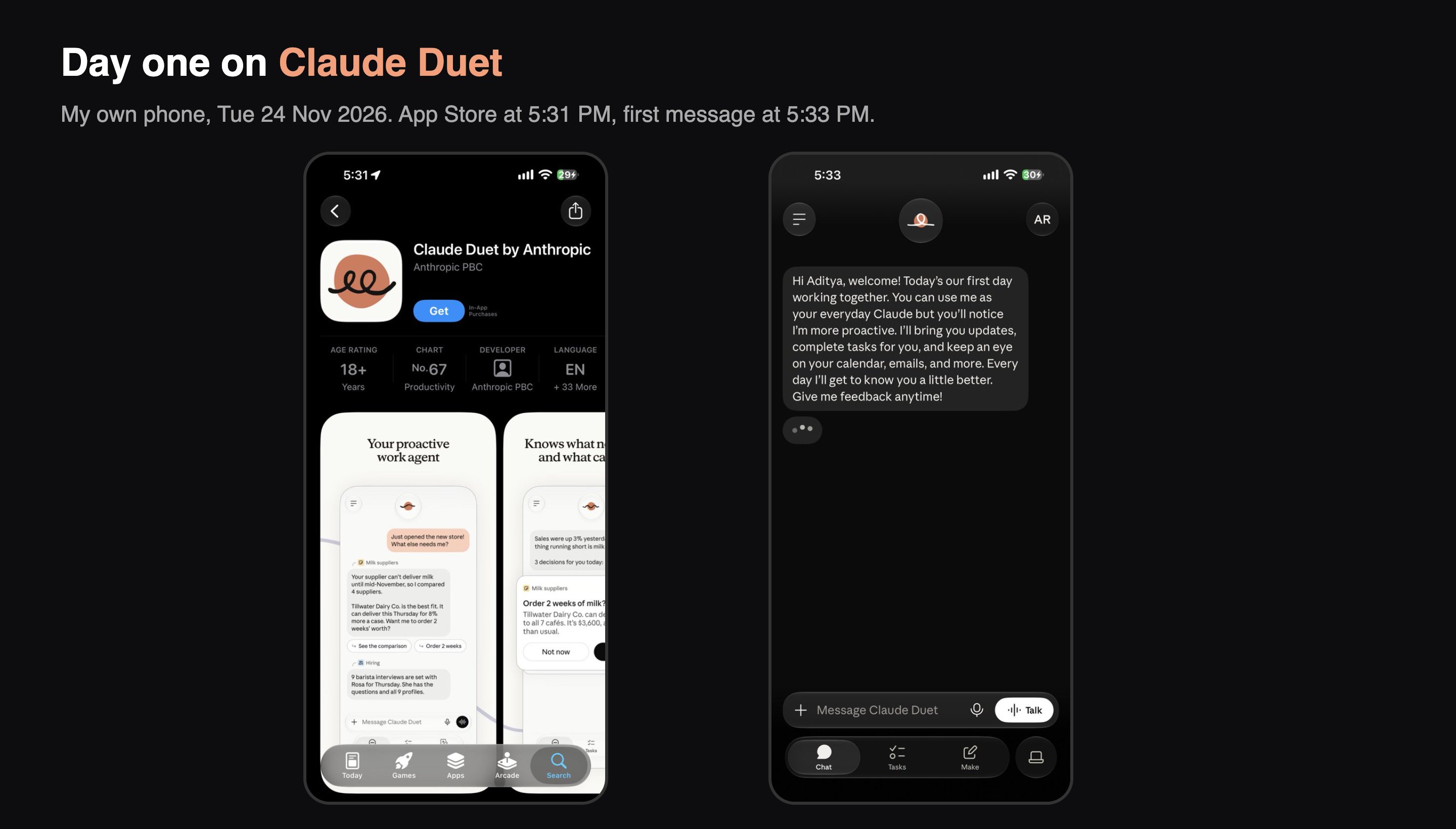
I got Claude Duet access yesterday, and I’m genuinely excited.
Its first message to me was: “Today’s our first day working together.”
I also went through what people are posting about it, and a lot of it is good. People say it brings them work before they ask, wakes them up with a brief, and keeps going while they are away. One tester said it caught a clash between his time off and a deadline he had missed.
Not everyone loves it though. Some say it is rough around the edges, and some say it eats their usage.
So I put it head to head with Grok Bot and OpenBot. One surprised me. One is still my daily driver. One has a usage problem worth talking about.
I run my own work through OpenBot, and I have already onboarded companies onto it. So I am biased, and I will tell you exactly where. But I also spent the last day reading docs, pricing pages, help centers and a lot of posts from people actually using these tools, so this is not just my opinion.
This is a long one on purpose. I want you to be able to make a solid decision after reading it. Jump to the heading you need.
The one-line version
OpenBot is a workshop I own. My tools, my keys, my floor.
Grok Bot is a team I rent in the cloud. Many hands, one monthly bill.
Claude Duet is an assistant who knocks on my door first, every morning, and asks what matters today.
Those three sentences explain almost every difference below. Everything else is detail, so here is the detail.
The 60-second verdict
If you only read one section, read this one. Here is who I would point to which tool, and why.
| If this is you | Best fit | Why |
|---|---|---|
| A solo founder or professional drowning in email and calendar, with a US Claude account | Claude Duet | It comes to you with a morning brief, reuses your Claude memory and connectors, and needs almost no setup |
| You want a team of specialist agents working in your own files, with your choice of model | OpenBot | Many agents, per-agent folders, any model from the plans you already pay for, and code you can read |
| You want a rented cloud team and do not want to run anything yourself | Grok Bot | A team of bots on a persistent cloud computer that hand work to each other |
| You are outside the US today | OpenBot or Grok Bot | Duet is US only in Anthropic’s docs, although a few people on X say India just opened |
| You are a team that needs shared workspaces and admin controls | OpenBot or Grok Bot | Both have team plans. Duet is on personal plans only for now |
| You hate babysitting an agent | Try Duet first | Early testers say it feels proactive without turning them into a manager, but it is one day of data for me |
What happened in the last five weeks
This market moved fast, and the timeline explains why people are comparing these tools right now.
| Date (2026) | What happened |
|---|---|
| 12 Oct | Grok Bot moves into The X Subscription: Premium at $30 a month is where it starts |
| 21 Oct | Anthropic opens the Claude Duet research preview for US Pro and Max users, by waitlist |
| 1 Nov | Elon Musk replies that the cost of serving Grok Bot was “unsustainably high relative to revenue” after users hit limits within days |
| 2 Nov | Grok Bot leaves beta with version 1.0 |
| 6 Nov | Duet can check on and approve Claude Code sessions from your phone |
| 9 to 10 Nov | The official Grok Bot account resets weekly limits for everyone |
| 13 Nov | Everyone on the US Duet waitlist is invited, with a note that Duet counts toward your Claude limits |
| 23 Nov | Select US accounts start getting $500 of Duet promo credit each week until 31 December |
| 24 Nov | Claude merges connectors and skills into plugins, with 10,000+ reported live. OpenBot hits 10K GitHub stars and ships v0.78.0. Some people report Duet opening in India |
What people are saying about Claude Duet
I wanted real opinions, not launch day hype, so I read a lot of posts from people who have used Duet for weeks.
Here is the pattern.
The good
The most useful thread I found came from a tester who said Duet is the first agent tool that feels proactive in a genuinely helpful way, and that it does not turn him into a manager.
His examples are specific. The first night he had it, a customer emailed him with an issue. He woke up to a solution, plus Duet had found two other accounts with the same problem.
He also liked three things that match what I saw. It already has your Claude context, memories and coding sessions, so it does not feel like switching tools. It is not personified, it is a work tool.
And the tasks tab plus channels sharing one memory keep things organised.

A solo founder shared his morning brief: a trial user turned into a paying customer overnight, two trials ending Tuesday with check-in notes already drafted, a churned customer back with a welcome note ready.
His line was “I just tap Send.” That is the Duet promise in one sentence.

The Verge tester said it was truly useful in places. It noticed that his upcoming time off left only a couple of working days before a big draft was due, proposed a fix, and drafted the Slack message to his editor.
The honest criticism
The same tester who loved it listed what needs work. Drafts in his voice came out too long and flowery at first and took a few rounds to tune. Reminders are only timed messages, so they do not appear on the task list. There is no Apple Calendar support.
He still feels he has to babysit it a little.
Others are blunter. One user wrote that timing is off, that Duet still feels rough around the edges, and that Anthropic should have polished it before running the promo.
Another simply said they do not like it. The Verge called it “a little neurotic and surprisingly helpful”, because it nagged him about an edit that was not urgent.


And then there is usage. Anthropic is upfront that Duet counts toward your Pro, Max or Ultra limits, that background checks count too, and that you may go through limits faster than normal.
Their own advice is to check Duet’s share in Settings, Usage after a few days and pause its proactivity if it uses too much. One Reddit user said a single task ate a whole reset. That is one report, so treat it as a signal, not a verdict.
How Anthropic says to get the most out of it
This part surprised me, and it is the best tip I found. Anthropic’s own tutorial says to give Duet a whole responsibility instead of a single task.
Instead of “draft replies to the emails waiting on me”, say “do not let anyone wait more than two days for a reply from me, draft the replies and bring them to me to send.”
Instead of “chase the latest overdue invoice in Stripe”, say “keep my invoices paid on time, chase anything overdue and bring me the reminders to approve.”
Instead of “brief me on this company before my 2 pm meeting”, say “make sure I never walk into a meeting unprepared, and the evening before, compile a one-page brief from our emails, docs and notes.”
You can also tell it what to leave out, for example “only tell me about email that needs a reply from me”, and what to put on a schedule, for example “do this every Friday afternoon.” That is how you turn an assistant into a system.
What people actually do with OpenBot
OpenBot is the one I know best, so I tried to look beyond my own setup and see how other people use it. The pattern is different from Duet. People are not using it as one assistant. They are building small teams.
A founder in France says he does not use OpenBot to code. He uses it to run sales and acquisition, with one agent that writes and publishes his X and Threads posts, another for LinkedIn, and a prospecting agent that spots people who like or comment on his posts.

A creator in Spain runs an organiser agent that hands work to four others, including one that applies to jobs and one that sends him the latest AI news.
A developer in Brazil built an agent just for dev and infra, whose only job is to audit and fix the scripts, workflows, routines and skills of his other agents.
A Frenchman published a 47 minute guide that starts from zero and builds three agents for a real estate agency: one tracks market prices, one prepares replies, and the weekly report lands on Telegram.
Another user said the big problem he had was constantly switching between Claude, ChatGPT Codex and Grok Bot, and that every time he tried to consolidate into one tool there was a tradeoff.
OpenBot was the one that finally stuck.

Then there is Workflows, the canvas where you see each step, edit it, pick a time and let OpenBot run it.
People compare it to a visual automation tool, but with agents inside each step. Some creators are making whole videos inside it.
My own story is smaller and real. I posted that I had never had a team read my note on a Friday afternoon, fix it that evening and ship it the next day, and that OpenBot did.

The criticism is fair too. One user complained that agents on OpenBot and similar apps are lazy: they find a problem and stop, and he has to ask them to continue again and again.
I have seen that. It is a reason to write clear standing instructions and to run routines instead of hoping for initiative. I have also filed a handful of issues on their GitHub myself, and the team moves fast. One of mine shipped three days after I filed it.
What people do with Grok Bot
Grok Bot is the most “company in a box” of the three. One user described it as his work agent after about a thousand hours of setup, and said the best part is multiplayer mode, with shared permissions, analytics and a page to browse the team’s bots.

Others say it is a different way to work. One person said he fired himself as the manager of his bots, because one of them runs the other nine now. Another says new bots take him four seconds to spin up, with a profile that has a name, a title and a description.
And then the usage story, which is the part I would not skip if you are thinking of paying for it.

A few days later the official Grok Bot account reset weekly limits for everyone, and said fixes were coming.

Reviews I read say the same thing in different words: it is a hard-working team, with one bot that sometimes needs waking up, and a weekly allowance that runs out faster than you expect when bots browse or run long jobs.
The deep feature breakdown
Now the part you came for. I built these tables from each product’s own help center and docs, plus posts from people using them.
Where something is my reading of the docs, I say so. I split them by the questions that actually decide the choice.
1. Basics: where it runs, what it can touch, which model
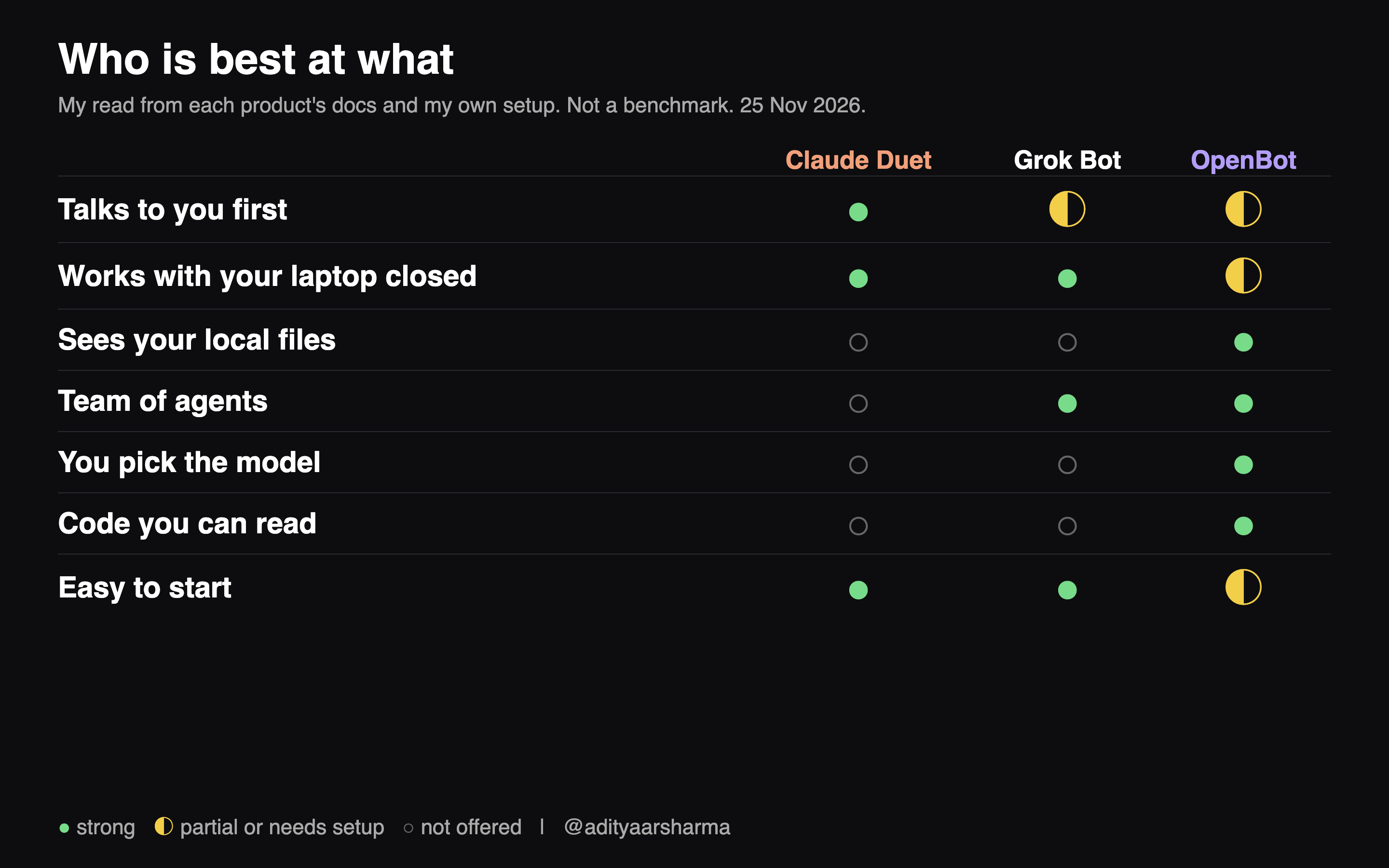
This is the first filter. If you need your agent to touch files on your own computer, or you want to pick the model, two of the three are already out.
| Claude Duet | Grok Bot | OpenBot | |
|---|---|---|---|
| Where it runs | Anthropic’s cloud computer | A persistent cloud computer shared by all your bots | Your Mac, Windows or Linux machine, a server you run, or a hosted server |
| Keeps working with your laptop closed | Yes | Yes | Only if the machine or server stays on, or you use a hosted server |
| Your local files | Cannot see all your files or projects | Works on its own cloud files. Runs commands on your desktop only if you allow it | Works from your folders, per agent |
| Model | Claude Opus 5.5 only | Grok Bot picks the model for each task, no picker | You pick per agent: Codex, Claude, Gemini, Grok or your own models, on the plans you already pay for |
| Browser | Own cloud browser. You cannot watch or take over | Uses sites through the shared cloud computer. Hands CAPTCHAs and logins to you | Agent browser with profiles. You can take over |
| How many agents | One conversation with topic channels that share one memory | A team of bots that coordinate in group chats of two to six, per one review | As many agents as you create, split by role or product |
| Apps | iPhone, Android, and claude.ai on the web | Desktop on Mac, Windows, Linux, plus iPhone and Android | Desktop on Mac, Windows, Linux, plus iPhone, Android and a web client |
2. Proactivity and memory: who starts the work
This is Duet’s strongest ground and the thing I was most curious about. Proactive does not mean the same thing in each tool.
| Claude Duet | Grok Bot | OpenBot | |
|---|---|---|---|
| Morning brief | Built in. Reads email and calendar, picks what matters, starts first steps | You set it up as a routine | You set it up as a routine or workflow |
| Checks while you are away | Every few hours, on purpose, to protect your limits. Messages you only when needed | Routines on a schedule. A review found a bot does not wake for new email unless you set a wake link | Routines, workflows on a canvas, and parallel tasks that agents can split |
| Scheduled work | Tell it “do this every Friday”. It may not always ask before acting on scheduled tasks | Up to 50 routines per bot when I read the docs. Approvals from routine-started work expire after about 30 minutes | Routines with schedules or webhooks. You write them |
| Task tracking | Tasks tab, only you can mark one complete. Finished files land in Make | Each bot has its own chat transcript and routine list | Threads view, and a Workflows canvas where you see each step |
| Memory | Your Claude memory, skills and connectors from message one. Searches past chats unless you turn that off | Each bot keeps its own role context. A few facts about you are shared. Files, browser sessions and logins are shared on the one computer | Each agent has its own folder, skills and notes. Group chats can share project folders |
| Teach it a task | You describe it in a message | Record one browser workflow, up to ten minutes, and it becomes a draft skill. Rolling out gradually | You write skills and instructions for each agent |
3. Integrations and marketplace: what it can plug into
Here is where Duet has something OpenBot cannot match today, and where OpenBot has something Duet does not offer at all. Duet has a huge plugin directory. OpenBot lets agents live where you already talk.
Duet launched with more than 6,000 connectors and plugins from the Claude marketplace, and on 24 November posts reported Claude merging connectors and skills into one plugin directory with 10,000+ listings.
That is a real moat. Gmail, Calendar, Drive, Slack with some limits, QuickBooks, HubSpot, Docusign and Calendly are on Anthropic’s list, plus Stripe and payments through Link by Stripe and Shop Pay, each with a one-time card.
What Duet does not have is a way to live inside Telegram, WhatsApp or Discord. It does not text or call anyone, and the only places to talk to it are its own app and claude.ai.
OpenBot agents can connect to Telegram, Slack, Discord and WhatsApp, which is how one popular guide ends with a weekly report landing on Telegram.
| Claude Duet | Grok Bot | OpenBot | |
|---|---|---|---|
| Plugin or connector marketplace | Claude marketplace, 10,000+ plugins reported on 24 Nov, 6,000+ at launch | Connectors and MCP, plus its own browser for sites without one | A Marketplace with an Agents tab and an Apps tab, and MCP servers you add yourself |
| Work apps | Gmail, Google Calendar, Drive, Slack (limited), QuickBooks, HubSpot, Docusign, Calendly, Stripe | Many tools through connectors and the browser | Apps such as Notion, Linear, Figma, Canva and Obsidian through the Marketplace, and any MCP server |
| Buying things | Link by Stripe and Shop Pay, one-time card, asks first | Through connectors and the browser, with approvals | Through apps and the browser |
| Passwords and keys | Never sees passwords. You type them into a separate form. 1Password sign-in is listed as coming | Vault, a connected password manager, or a secure form | A Vault for keys, passwords and cards, and you choose which agents can use each one |
| Where you can chat with it | Its own app and claude.ai. No texts or calls | Desktop and phone apps, X Chat, @bot on X, and a Team Bot in Slack | Desktop, phone apps, web, and agents that message you on Telegram, Slack, Discord and WhatsApp, with voice in channels |
| Generate media | Decks, dashboards, models and docs in the Make tab | Through tools and connectors | Image and video generation with credits inside Workflows |
4. Control, safety and privacy: who is holding the keys
An agent that reads your email and can send messages is a trust decision. All three ask before important actions, but the control surface is different.
| Claude Duet | Grok Bot | OpenBot | |
|---|---|---|---|
| Approvals | Asks before it sends, pays, signs or deletes. Finishes the rest and brings the approval back to you later | Depends on the tool and risk. You can set Ask first rules for sending, publishing, deleting or buying | Per agent permission levels, such as workspace only, ask first or full access. Check the default for each agent |
| Hard limits | Refuses trading securities, moving money between accounts and accessing someone else’s account, even if you approve | Hands human-only steps like CAPTCHAs to you | You decide through permissions and the Vault |
| Sensitive data | A filter blocks card and ID numbers. Health and finance details only go out if you say so | Bots sign in without seeing values. Do not treat separate bots as a security boundary, since they share one computer | Keys stay in the Vault. Files stay on your machine unless an agent sends them |
| Admin for teams | Not on Team or Enterprise plans yet | Team seats, Team Bots and enterprise options through Cursor | SSO, SCIM and an audit log for members, roles and agent access. It does not log every tool call |
| Code and licence | Closed | Closed. Cloud data storage required | Code is open to read. Free for personal use under a noncommercial licence, paid for work |
5. Price and usage: what it really costs
Price is where the three are most different, and where headline numbers mislead. Duet looks free if you already pay for Claude, but its background work uses the same limits as everything else. Grok Bot has the clearest meter.
OpenBot is free for personal use, but it runs on AI plans you still pay for.
| Claude Duet | Grok Bot | OpenBot | |
|---|---|---|---|
| Plan needed | Claude Pro ($20), Max (from $100) or Ultra ($200), in the US | Premium ($30), Super ($100) or Ultra ($200) on The X Subscription, or an eligible Cursor plan | The app is free for personal use. You bring your own AI subscriptions. Hosted servers and work licences are paid |
| What you pay extra | Nothing extra in the preview. Background checks and big jobs use your Claude limits | Weekly usage is shared with Cursor and Grok apps. Extra usage is prepaid credit | Your AI plans, plus a hosted server if you want one |
| Where people get hurt | Hitting limits sooner than with chat alone. Anthropic gives resets: 3 for Pro, 1 for Max and Ultra, expiring 15 Dec | Weekly pool draining fast on browsing and long jobs, and 1 Nov Musk comment on serving costs | Time spent on setup, and the Mac needing to stay awake |
| Promos right now | Select US accounts get $500 of Duet credit each week to 31 Dec | A reset in early November. Super is being questioned by some users | Work licence free until 1 December, per the pricing page |
Here is the quick maths I would do for a solo person. Duet on Pro costs what you already pay for Claude, so the real cost is limits. Grok Bot starts at $30 a month and you should set a spending cap.
OpenBot costs nothing for the app if you already pay for Claude or ChatGPT, and you pay for a server only if you want agents running without your machine.
6. Where each one falls short
Every product has a ceiling. These are the ones that would make me pause, said as plainly as I can.
| Claude Duet | Grok Bot | OpenBot | |
|---|---|---|---|
| Biggest gap | No local files, no model choice, US only on paper, one conversation instead of a team | No model picker, one shared computer for all bots, usage limits | Not proactive by default, you build the routines. Needs your machine awake unless hosted |
| What users report | Rough edges, drafts too long, no Apple Calendar, reminders not on the task list, nags | Weekly limits drain fast, bots sometimes need waking, cost to serve | Agents can stop after finding a problem, setup takes effort |
| What is fixed fast | Anthropic ships weekly: Claude Code control on 6 Nov, plugins merge on 24 Nov | Limits reset, fixes announced, left beta on 2 Nov | Releases almost daily: v0.77.0 on 23 Nov and v0.78.0 on 24 Nov |
Which one for which job
Features only matter against a real job. Here is how I would match them.
Clearing an inbox and staying on top of customers as a one person business: Duet. This is exactly what it was built for, and people who use it this way are the happiest.
Running sales, content, research and operations with different agents for each: OpenBot. The founder in France and the agency guide are the pattern.
One agent per job, one place to see them all, and a report on your phone.
A cloud team that hands work off while you sleep, and you are fine watching a meter: Grok Bot. The multiplayer mode and Team Bots are the draw for companies.
Coding with Claude Code from your phone: Duet now lets you check and approve sessions from your phone, which is a quiet but big win for developers.
Privacy sensitive work on your own machine: OpenBot. If you want your files to stay on your computer, it is the only one of the three built that way.
Using more than one model: OpenBot. Duet is Opus 5.5 only, and Grok Bot chooses for you.
How to start each one without regret
A few things I would do differently if I started today.
With Duet, connect only email and calendar on day one. Tell it what to report and how often.
Check Duet’s share of your usage after a few days. Give it a whole responsibility, not one task.
With Grok Bot, set a monthly cap on extra usage before you do anything else. Test a skill on a real one-off task before you turn it into a routine. Remember that all your bots share one computer.
With OpenBot, start with two agents, not ten. Give each one a clear job and written standing instructions so it keeps going.
Add a small auditing agent that checks the others, like the Brazilian developer did. Move one repeatable job into Workflows.
Where I land
No absolute opinion yet. It is the early days of Claude Duet, and I am looking forward to where it goes. I only have a day with it, and I do not want to judge a research preview on day one.
The same goes for Grok Bot, because I want to see how this market shakes out.
For now I am staying on OpenBot for my real workflow.
It runs on my machine. I can read the code. I choose the model for each agent. I control the keys. And I have already onboarded companies onto it, so I know how it behaves with a team.
That is a me thing, and it comes down to control. Duet is great at keeping me informed. OpenBot gives me a place to run my work.
But I would not tell you to use only one. They help in different ways. I can easily see myself using Duet as the morning brief and OpenBot for the heavy lifting. They are not enemies. One is the front desk, the other is the whole office.
The honest answer is that this space is changing every week. A tool that is rough today can be the best one next month, and a tool with a usage problem can fix it overnight. So revisit this choice often.
If you are a US Pro, Max or Ultra user, try Duet this week while the resets and promo credit are live.
If you want control, many agents and your own files, try OpenBot.
If you want a rented team, Grok Bot is real, just set a spending cap first.
Want more of this?
I write about running AI agents in real work every week in my newsletter, Agents in Production, on Substack. What works, what breaks, and what is worth your time, with the same level of detail as this article.
Subscribe here: https://adityaarsharma.substack.com
And follow me – @adityaarsharma on X for more AI agent updates like this one.
Which one are you running right now, and why? Tell me in the replies. I read every one.