Generative Engine Optimization: 5 Things to Skip
On this page, 8 sections
The short version
Google has a page that lists what you can ignore when you try to rank in AI answers. It names five things: llms.txt, chunking your content, rewriting for AI, buying mentions, and overdoing structured data.
I checked what my own site and my own server log say about each one. The one that surprised me is llms.txt. In 11 days my server got 66 requests for it. Every one returned 404, and none came from GPTBot, OAI-SearchBot, ClaudeBot or PerplexityBot.
I build Sitewalk, a site audit tool, so a few numbers below come from its audits. I mark them. Every outside fact was read on 24 November 2026, and the log and page numbers are mine.
If you only read one thing: for Google, GEO is the same job as SEO. For the other AI search tools, I only have crawl logs, and they point the same way.
1. What Google says to ignore
The page is Optimizing your website for generative AI features on Google Search. It shows a last updated date of 10 July 2026. The section is called “Mythbusting generative AI search: what you don’t need to do”.
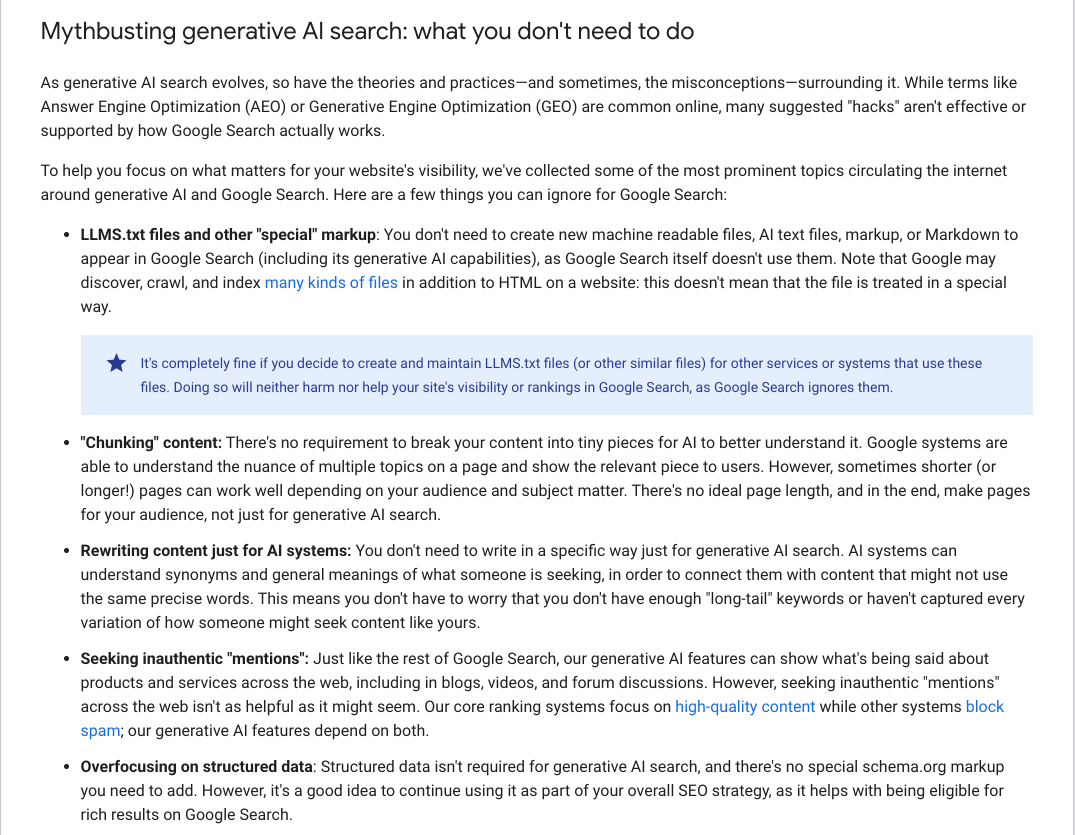
Here is the list next to what I checked.
| What Google says to ignore | What I checked | What I found |
|---|---|---|
| llms.txt and special markup | Requests for /llms.txt in my server log | 66 requests in 11 days, all 404, none from the big AI crawlers |
| Chunking content | Length of my pages in raw HTML | Median 1,855 words across 403 posts, not chunked |
| Rewriting for AI | Whether I keep a separate version for bots | No, bots get the same HTML a reader gets |
| Seeking inauthentic mentions | Nothing to measure on my side | Skipped, I did not test this one |
| Overfocusing on structured data | JSON-LD on my posts | 403 of 403 have it, 62 have FAQPage, added by plugin |
Google also says the AI features sit on top of its core ranking systems and use techniques like retrieval, which means fetching pages from the Search index. So the page you need is the one that already ranks.
2. llms.txt: nobody asked for mine
My log covers 12 November 23:58 UTC to 24 November 04:34 UTC, 383,171 requests. My site sits behind Cloudflare and the user agent still reaches the server. I counted by user agent text only, so every name below is “labelled as”, not proven.
The file does not exist on my site. Requests for it:
- 66 requests for /llms.txt, all 404.
- The biggest askers were SEOJuice-SearchBot with 18 and Meta’s external agent with 14, then a site auditor with 12.
- Googlebot asked twice. Google says its Search ignores the file.
- GPTBot, OAI-SearchBot, ChatGPT-User, ClaudeBot, Claude-User, Claude-SearchBot, PerplexityBot, Perplexity-User and Applebot asked 0 times.
Those same crawlers did visit. In the same log GPTBot made 901 requests, OAI-SearchBot 489, ClaudeBot 858 and PerplexityBot 729. They came for pages. They did not come looking for a file I do not have.
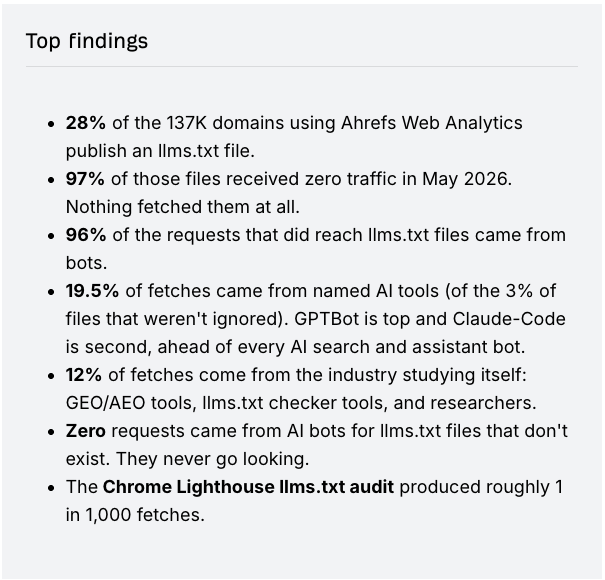
That matches the biggest study I could find. Ahrefs looked at 137,210 domains with traffic in May 2026, published on 15 June 2026. 28% of them publish an llms.txt. 97% of those files received no requests at all in May. And zero requests came from AI bots for files that do not exist.
John Mueller of Google put it more bluntly, as quoted by Search Engine Journal. He said “I don’t think anyone knows” and called it “purely speculative for now”, adding that the file has existed for years and none of the AI systems use it.
Google’s guide adds one fair line. It is fine to make the file for other services. It will neither harm nor help your visibility in Google Search, because Google Search ignores it.
The Ahrefs study has one more detail worth knowing. The closest thing to a real reader in its data is coding agents. If your users work with coding agents, for example on developer docs, the file has a better chance of being read. For a blog like mine, it sits at the bottom of the list.
Sitewalk’s numbers show the other side. On 23 November it had audited 89 sites since its llms.txt check went live on 4 November. 42 of them, 47%, had no llms.txt. People are not skipping it by accident. Most just have not made one, and nothing bad shows up.
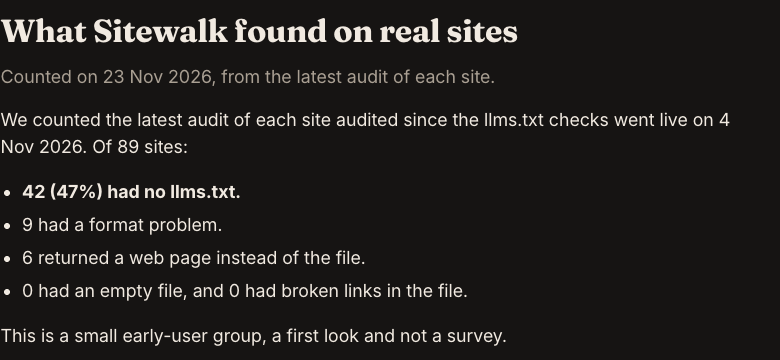
It is a small early-user group, so read it as a first look, not a survey. If you want the longer story, I wrote about it earlier in Does llms.txt Work? What AI Vendors Actually Say About It.
3. Chunking and rewriting: my pages are plain
Chunking means cutting a page into tiny self-contained pieces so an AI can lift them. Google says there is no requirement for it, and no ideal page length.
I never did it. I fetched all 403 of my published posts as raw HTML, with no JavaScript, and counted the visible words. The median is 1,855. The shortest is 746 and 37 posts are under 1,000.
Each post has one H1, a canonical URL, and short paragraphs under clear headings. That is how I write for a person on a phone, and it is the only version of the page that exists. A crawler gets what a reader gets.
I have not tested a chunked page against an unchunked one, so I cannot say it never helps. I can say Google’s own guide tells you not to bother, and that my pages are not built that way.
The same goes for rewriting content just for AI systems. Google says AI can match synonyms and meaning, so you do not need to chase every long tail phrase.
The version I would rather spend time on is the one Google asks for first: content with a point of view that a summary cannot copy. That is why this post is built from my own log and my own pages and not from a list of tips.
4. Structured data: I have it, and I cannot prove it matters
Of my 403 posts, all 403 carry JSON-LD in the raw HTML. 375 declare a BlogPosting or Article. 62 carry a FAQPage block, which is the FAQ you see at the bottom of some posts.
A plugin adds all of it. I did not hand write any, and that is why I am relaxed about it. It costs me nothing to keep.
What I cannot tell you is whether it changes anything in AI answers. Google’s guide says structured data is not required for generative AI search and there is no special schema.org markup to add. It also says to keep it, because it helps with rich results, and to make sure it matches the visible text on the page.
That last part is the rule I would check. A FAQPage block that does not match the questions on the page is worse than none.
5. What I would check first on any site
If you want to do something useful today, skip the new files and run these five checks. Each takes a few minutes.
- Is the page indexed with a snippet? Google says that is the technical requirement for its AI features, and there is nothing extra. Check the page in Search Console.
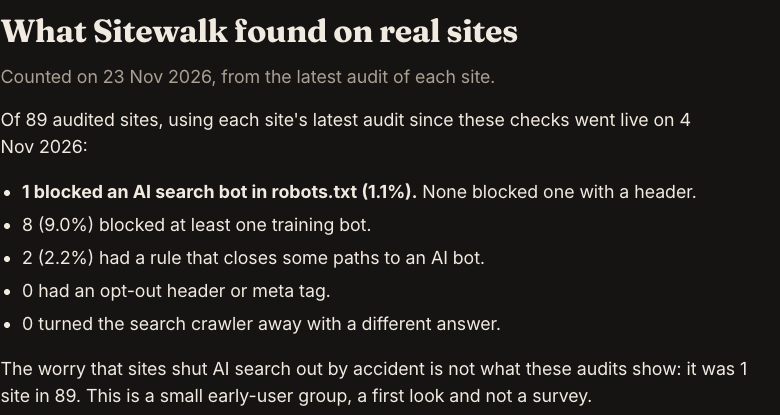
- Does robots.txt let search bots in? In Sitewalk’s 89 audited sites, 1 blocked an AI search bot, and 8 blocked at least one training bot. Blocking by accident is rare, but check it. My own robots.txt names 29 crawlers and allows all of them.
- Is the answer in the raw HTML? Fetch the page without JavaScript and search for a sentence from it.
- Who actually visits? Count AI user agents in your server log. A tool that has crawled you shows up there, and a dashboard number can be a different thing.
- What does Google report? Search Console now has a Generative AI performance report. Google points to it in the guide.
Two of those I have covered in detail. Which AI Crawlers Visit My Site: 25 Days of Real Access Logs shows how I read the log, and How to Block AI Crawlers in WordPress covers robots.txt and what it cannot do.
For the raw HTML check, this is the whole command. Replace the address and the sentence with your own.
curl -s https://example.com/your-page/ | grep -c "a sentence from your page"A count of 1 or more means the sentence is in the HTML a crawler receives. A 0 means it is added by JavaScript, and that is the first thing to fix.
6. What I am not claiming
This is one site, over 11 days. I counted by user agent text, and anyone can send any name. The log is also only what reached my server, behind Cloudflare.
Google’s guide is about Google Search. ChatGPT, Perplexity and the others can behave differently, and I only have their crawl logs, not their rules. A crawler not asking for a file in my log is a fact about my site, not a promise about their future.
And none of this says GEO is fake. It says the loud tactics are not where the evidence is. If you want to see how little traffic AI answers sent me, ChatGPT Business Hub Counts Clicks. My Logs Counted 3. has that count.
My plan is small. Keep the pages plain and specific, keep robots.txt open, and check the log on Mondays. If something in it changes, I will write it up with the numbers.
Frequently asked questions
Is generative engine optimization different from SEO?
For Google, mostly not. Its guide says the AI features rely on its core ranking and quality systems, and that the best practices for SEO continue to apply. For other AI tools there is less official guidance, so a server log is the best evidence you can collect yourself.
Should I add an llms.txt file?
It will not hurt, and Google says it is fine to create one for other services. But Google Search ignores it, and in my log 66 requests for it came from no major AI crawler. Ahrefs found 97% of existing files got zero requests in May 2026. I would do it last.
Does structured data help my page appear in AI answers?
Google says structured data is not required for its generative AI features and there is no special markup to add. Keep it accurate and matching the visible text. I have it on all 403 of my posts, and I cannot show from my data that it changes AI results.