Structured Data and AI Answers: What Schema Is Actually Doing for You Now
On this page, 7 sections
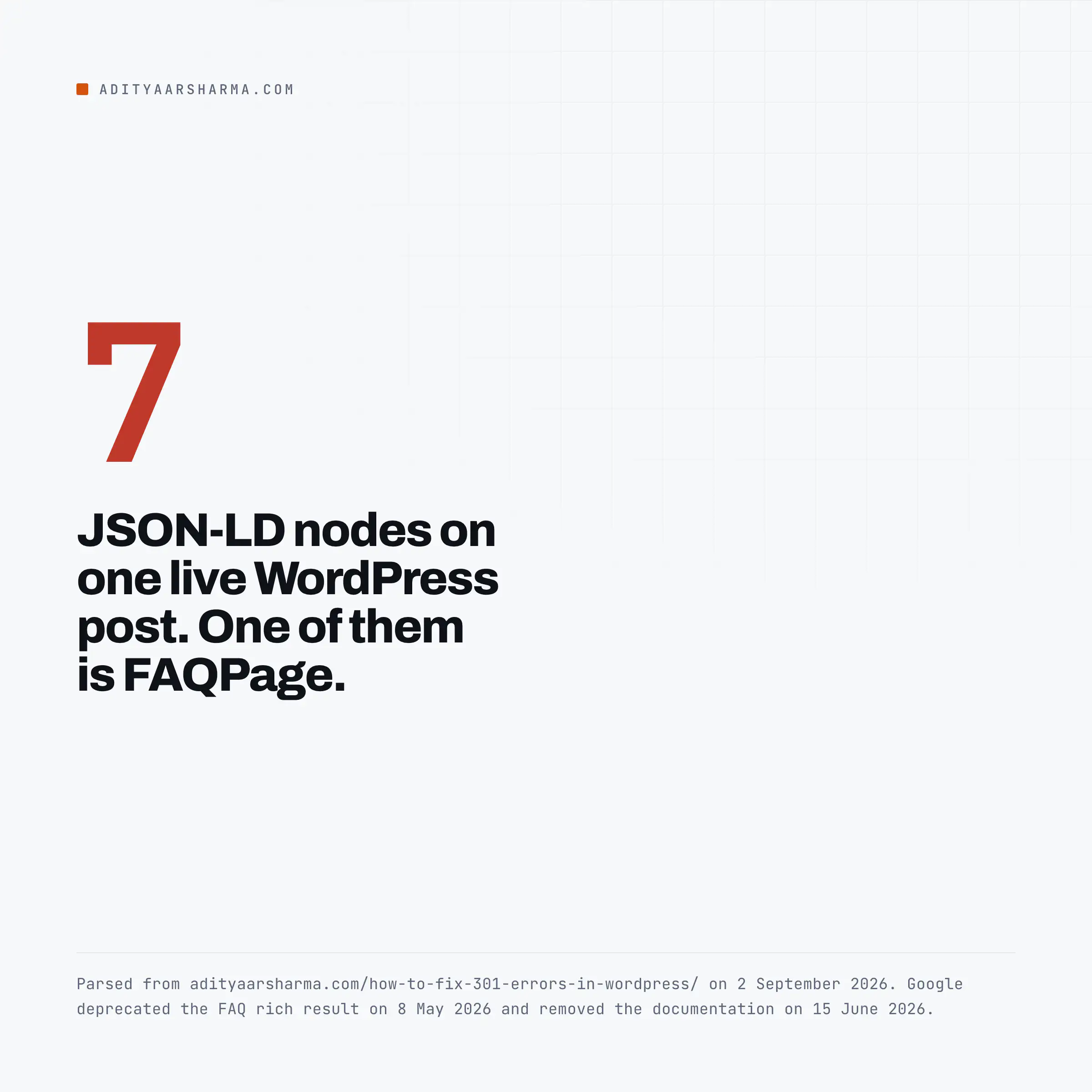
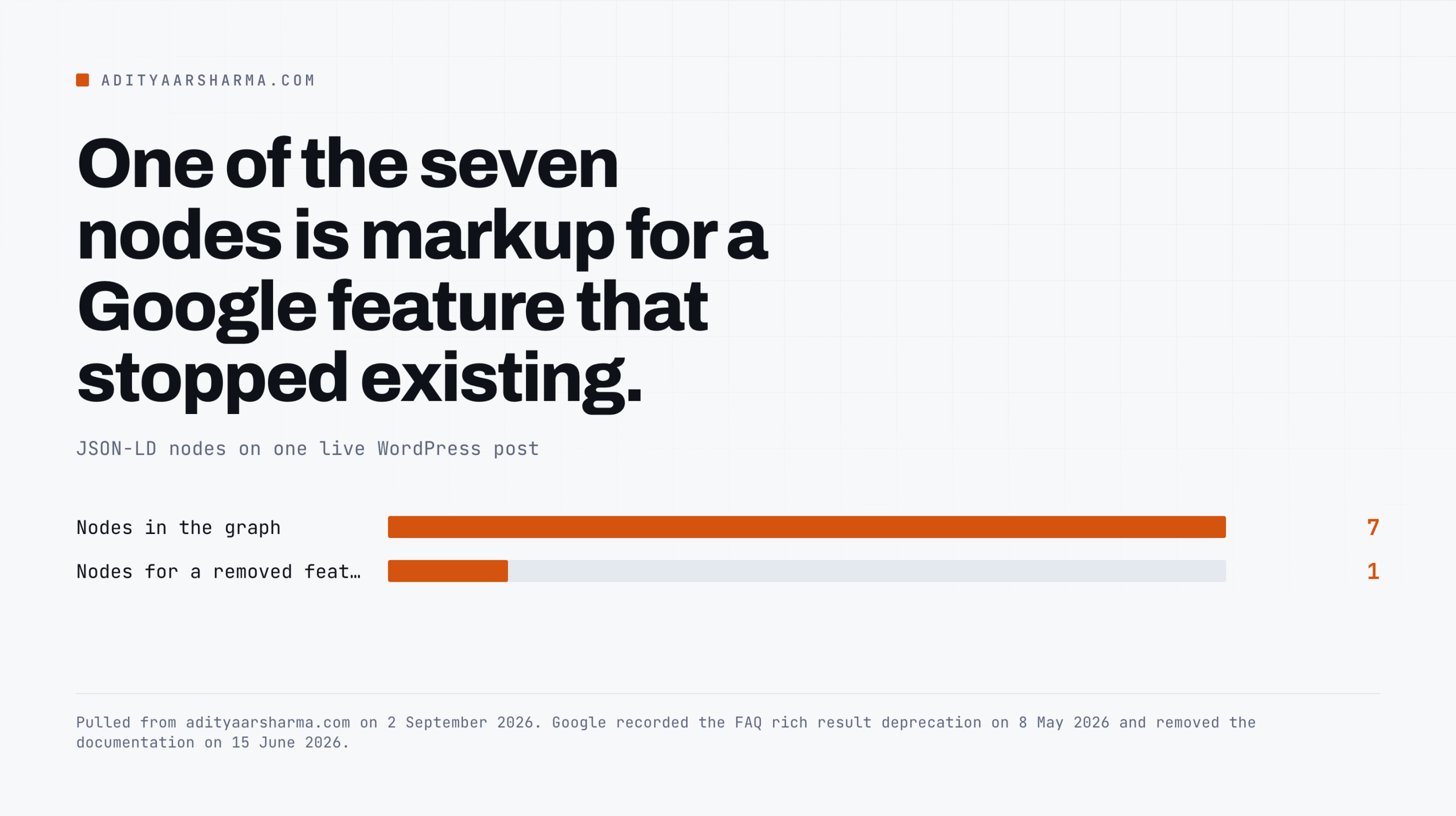
I pulled the JSON-LD off one of my own WordPress posts on 2 September 2026 and printed the types in the graph. One of the seven nodes is markup for a Google feature that stopped existing four months ago.
$ curl -s https://adityaarsharma.com/how-to-fix-301-errors-in-wordpress/ | python3 -c "
import re,json,sys
h=sys.stdin.read()
for b in re.findall(r'<script type=\"application/ld\+json\"[^>]*>(.*?)</script>', h, re.S):
    d=json.loads(b)
    for node in d.get('@graph',[d]):
        print(node.get('@type'))
"
['Person', 'Organization']
WebSite
ImageObject
BreadcrumbList
['WebPage', 'FAQPage']
Person
BlogPosting
The FAQPage node earns nothing.
Google’s Search Central changelog records the FAQ rich result deprecation on 8 May 2026, and on 15 June 2026 the documentation for it was removed outright, with the reason given as the feature no longer being shown in search results.
The old documentation URL now redirects: curl -IL developers.google.com/search/docs/appearance/structured-data/faqpage lands on the changelog anchor #removing-faq-rich-result. Checked 2 September 2026.
Why it is still there
That markup is still being generated, on my site and on a large share of WordPress sites, by plugins that added FAQ schema when it was a rich result and never removed it.
It is a good illustration of the whole problem with this topic: the markup outlives the reason for the markup, and nobody re-checks.
The finding, stated plainly
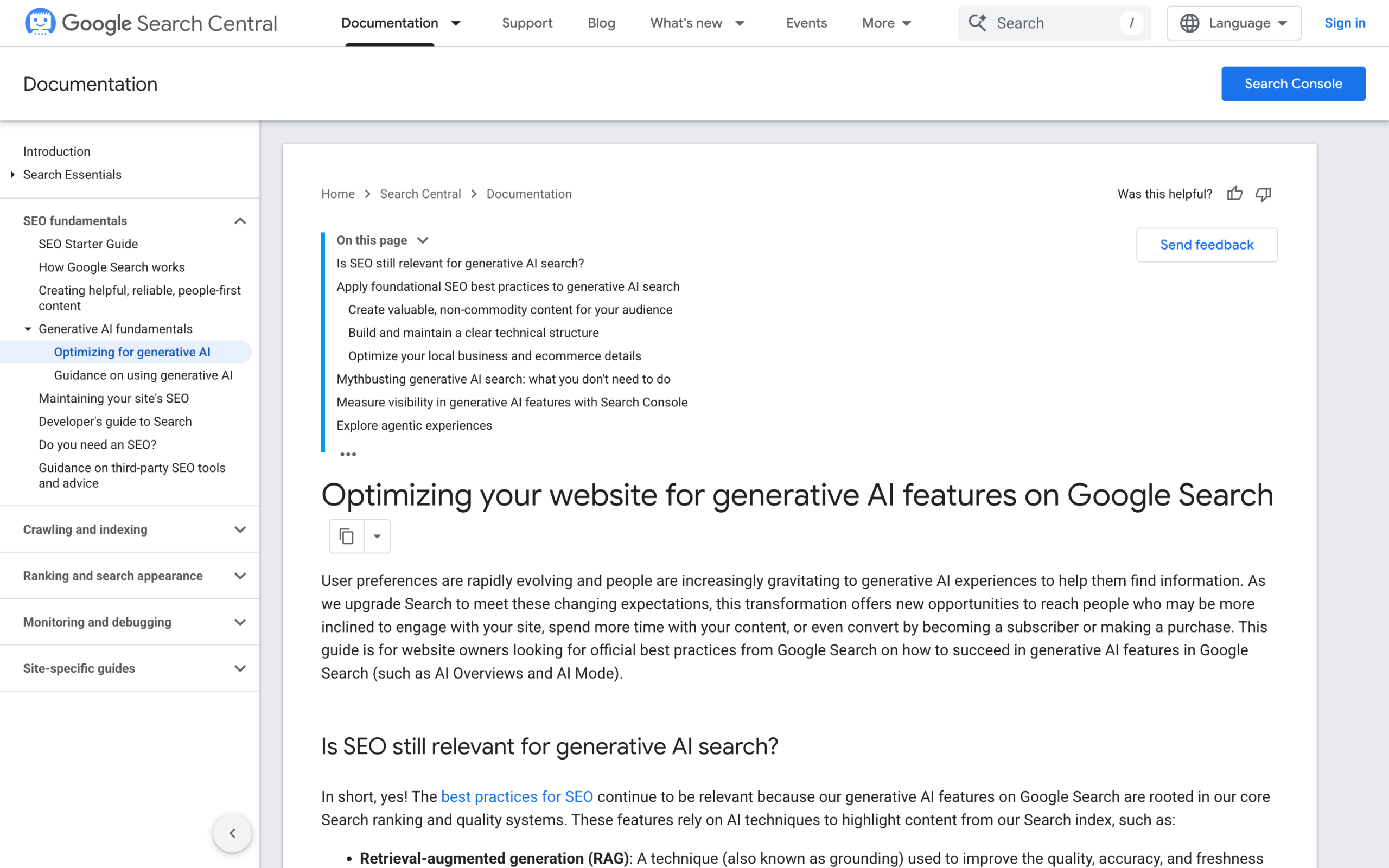
Google documents structured data as a route to rich results in Search. It documents no role for structured data in generative AI answers, and says so directly.
From the mythbusting section of its generative AI optimization guide, last updated 10 July 2026: structured data “isn’t required” for generative AI search, and there is no special schema.org markup you need to add.
The same section adds that it is still worth using as part of ordinary SEO, because it makes you eligible for rich results.
What Bing says, and what it leaves out
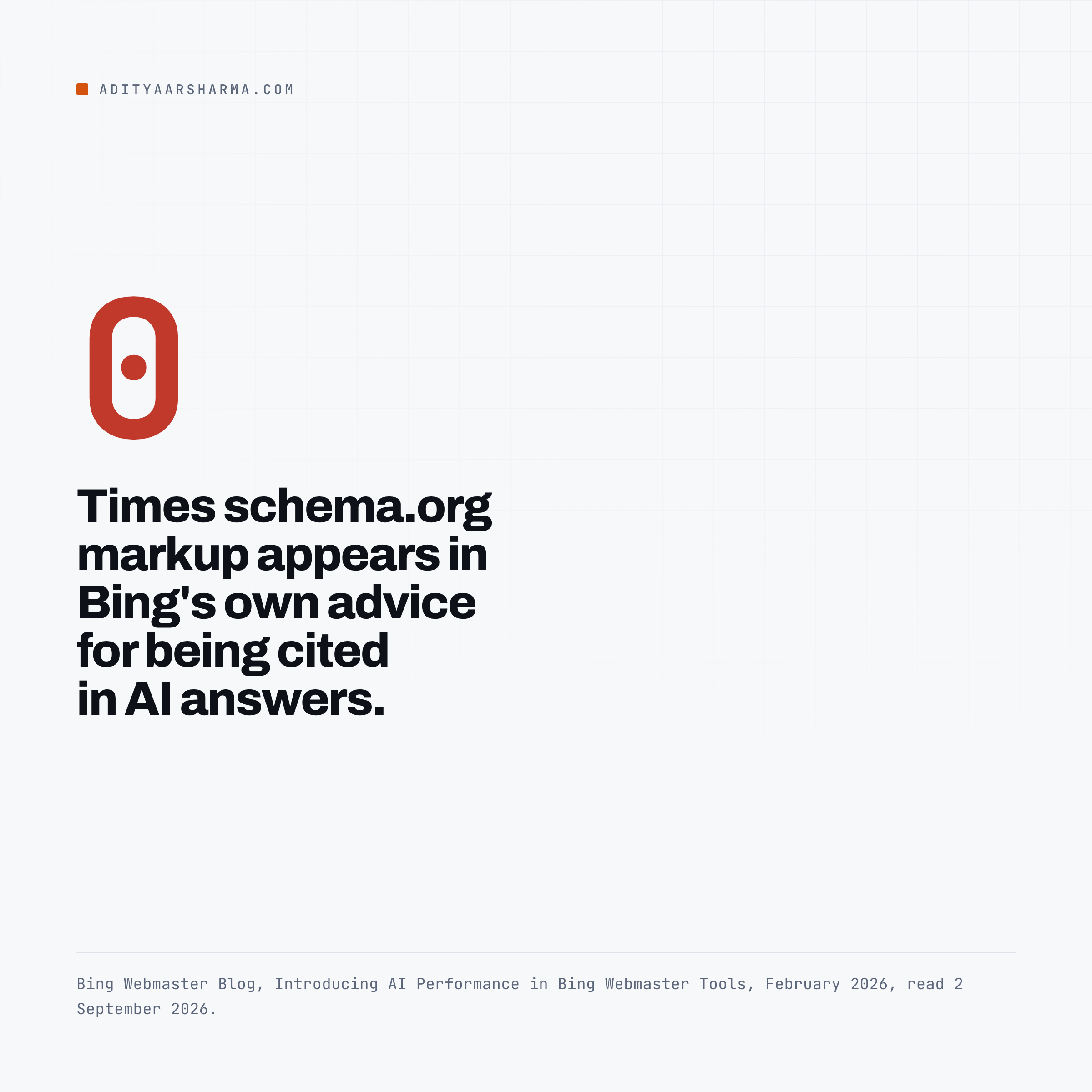
Bing, in the AI Performance announcement from February 2026, gives content advice for being cited in AI answers: clear headings, tables and FAQ sections, supporting claims with evidence, keeping content current, and aligning text, images and video so they describe the same entities.
Note what is not in that list. Schema.org markup is not mentioned once.
The honest split
So the honest split is: schema buys you rich result eligibility, which is measurable. Everything else attributed to schema in the AI context is a hypothesis that neither of the two vendors publishing guidance has endorsed.
What Google actually documents
Worth reading the introduction to structured data for what it does and does not promise. It is careful.
Structured data can make a page eligible for a rich result.
Eligible is the load-bearing word: Google says you must include all required properties to be eligible, and that more complete recommended properties make enhanced display more likely, while explicitly preferring fewer accurate properties over many badly formed ones.
The four case studies, read carefully
The page also carries four case studies. Rotten Tomatoes, 100,000 pages marked up, 25 percent higher click-through on marked-up pages.
Food Network, 80 percent of pages converted, 35 percent increase in visits. Rakuten, 1.5 times more time on page and 3.6 times higher interaction rate on AMP pages with search features.
Nestle, 82 percent higher click-through for pages showing as rich results. Those are Google’s numbers on Google’s page, undated on the page itself, from companies with an interest in the outcome, and none of them is about AI answers.
Cite them for what they are, which is a case for rich results, and stop there.
Two constraints that do carry over
Two constraints in the guidelines do carry over into the AI context, and they are the ones worth enforcing:
- The markup must describe content visible on the page. Google’s guidelines say not to add structured data about information that is not visible to the user, even if the information is accurate, and not to build empty pages to hold markup. Its AI features guidance repeats it as a best practice: make sure your structured data matches the visible text.
- Measure it as a before and after, per URL. Google’s own recommended method is to pick stable, reasonably trafficked pages with several months of Search Console history, add the markup, confirm with the URL Inspection tool that Google found it, then compare in the Performance report filtered by URL. That is a real experiment design, and it is in Google’s own documentation, and almost nobody runs it.
What practitioners assume, and where the assumption comes from
Four claims circulate constantly. None of them is supported by vendor documentation as of 2 September 2026, and I could not find a controlled test behind any of them.
- “Schema makes you more likely to be cited.” Google says structured data is not required for generative AI search. Bing’s citation guidance names page structure and evidence, not markup. If schema helped citation rates, both vendors had an obvious opportunity to say so in documents written specifically about being cited.
- “
sameAsand Organization markup make you a known entity.” Google’s introduction does say it can make general use ofsameAsand other schema.org properties, and that some elements may be used to enable future features. That is a long way from a mechanism you can point at, and it is the same sentence that has been in that page for years. - “FAQPage helps the model answer questions about you.” The rich result is gone. The markup is still parseable, and there is no documented consumer for it in an AI context. Bing recommends FAQ sections on the page, which is a content structure recommendation, not a markup one.
- “More schema types is better.” Google’s own guidance argues the opposite: fewer, complete, accurate properties beat many incomplete ones.
The plausible mechanism, named honestly
There is a plausible mechanism behind the general belief, and it is worth naming rather than dismissing.
Retrieval-augmented generation, which Google describes as the technique behind its AI features, retrieves pages from the Search index using the core ranking systems.
Anything that improves ranking improves the retrieval pool. Rich result eligibility can improve click-through, click-through data feeds nothing directly but the page performs better, and so on.
That chain is speculative at every link, and it is not the same thing as a model reading your JSON-LD.
Audit your own graph in one command
The script at the top of this post is the whole audit. Run it against ten of your own URLs and look for three things.
- Deprecated types.
FAQPageandHowToare the two to hunt. HowTo rich results were retired in August 2023 and the documentation removed at the same time. FAQ followed in May 2026. If your theme or SEO plugin still emits either, you are shipping dead weight in every page’s head. - Duplicate nodes. My graph above contains
Persontwice: once merged withOrganizationas the site publisher, once as the article author. That happens when a plugin and a theme both write an author node. It is not fatal, and it is a sign that two things are generating markup and neither knows about the other. - Claims not on the page. Ratings, prices, availability and dates that the visitor cannot see are the guideline violation Google names explicitly. On WordPress this usually comes from a review or product plugin left configured after a template change.
Validate, then check Search Console
Then validate what survives with the Rich Results Test and check the enhancement reports in Search Console, which is the only place you find out that Google parsed your markup and rejected it.
Validation in a tester and acceptance in production are different events, in the same way that a redirect that resolves in a browser can still be a chain Google refuses to follow.
The WordPress-specific part
Nearly every WordPress site emits a single JSON-LD graph from its SEO plugin, and nearly every site also has a theme, a block library and a couple of feature plugins that each want to add their own.
The result is what I printed above: one graph, seven nodes, at least two authors, and one node for a feature that no longer exists.
Why the failure is silent
Because it is generated rather than hand-written, the failure is silent and it survives redesigns. The markup is produced from post meta, so it keeps emitting long after the visible page changed.
This is the same class of problem as any other generated output on WordPress: the generator is right, the inputs went stale, and nothing checks.
If you are already running agents against your own WordPress install, a scheduled pass over your sitemap that prints the type list per URL and diffs it against last week is about twenty lines and catches this the day a plugin update changes the graph.
What to watch next
Worth watching separately: WordPress core is moving toward machine-readable interfaces of its own, and what landed in WordPress 7.0 matters more for how agents read a site than any schema.org property does.
The other thing to keep in view is that markup is a trust surface too, and a site serving markup that disagrees with its visible content looks, from the outside, exactly like a site quietly serving different content to crawlers.
Do this today
Run the audit script against your ten highest-traffic URLs today and count how many still carry FAQPage. That number is the honest measure of how much of your structured data is doing work.
More on ai search and wordpress
- llms.txt for WordPress: What the Spec Actually Says and Whether Anything Reads It
- robots.txt for AI Crawlers: The Actual User-Agent Strings, and What Each One Honours
- How to Measure Whether AI Search Sends You Anything
Resources
- Introduction to structured data markup in Google Search, last updated 10 December 2025.
- Optimizing your website for generative AI features on Google Search. The mythbusting section is the one to read.
- Google Search Central changelog. The 8 May 2026 and 15 June 2026 entries cover the FAQ deprecation and documentation removal.
- Structured data general guidelines, the rules on visible content.
- Rich Results Test and the list of structured data features in Google Search, which is the current, authoritative list of what still produces a result.